English| EUR
Suggested for you
More currencies
Choose a language
Sicily's largest active volcano is crossed by a network of unpaved forestry roads and old lava tracks that ordinary hire cars cannot use. Quad excursions exist to reach them. This guide explains how the etna quad bike guide operations are structured, when riders should turn up, and what the mountain itself dictates about timing.
Quick answer
Access to the mountain itself is free — entrance costs 0 EUR — while quad excursions are privately run and priced individually. Operators at Rifugio Sapienza work daily from 09:00 to 18:00, and the recommended arrival window is 09:00–14:00, when the weather is clearer and afternoon mountain cloud is less likely to close in over the higher tracks.
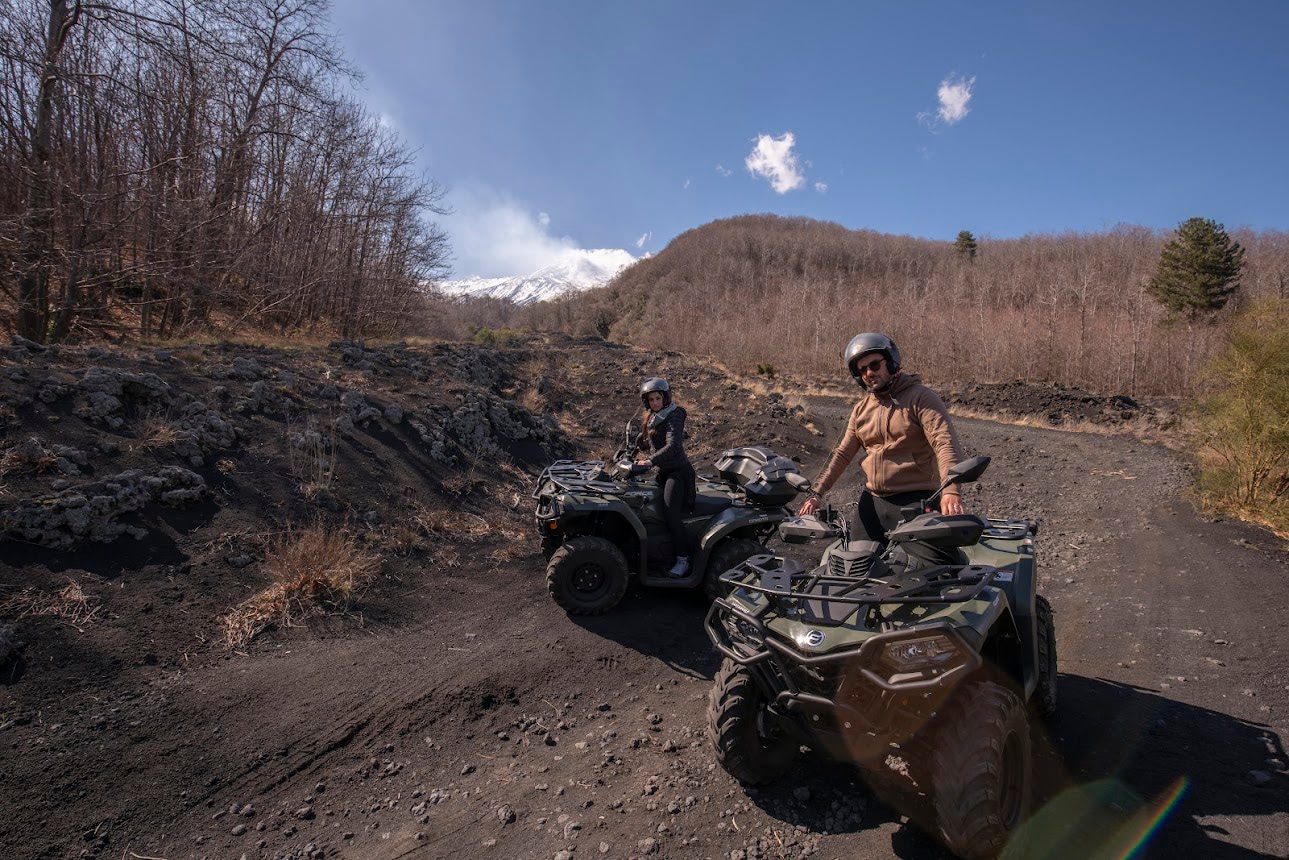
Etna is not a single cone but a mountain rebuilt constantly by its own eruptions, and the tracks quad riders use today are frequently roads that lava buried and bulldozers reopened. Some sections date from the 1983 eruption, when engineers first attempted to divert a flow with explosives. That history is why the terrain varies so sharply within a few kilometres: black ash fields, pine forest on the Nicolosi side, and hardened flows that crunch underfoot. An etna quad bike excursion is essentially a way of covering that variety without walking it. What a visitor is actually dealing with is a mountain, not an attraction with a turnstile. The volcano is a UNESCO World Heritage site and sits inside the Parco dell'Etna, and the summit craters remain under the authority of volcanological monitoring — routes shift when activity does. Quad tours on Mount Etna therefore run on the flanks rather than the summit, typically through the Silvestri craters area, lava tunnels, old ash quarries and abandoned lava flows above Nicolosi. Guides ride lead and sweep. Machines are automatic in most fleets, which is why operators accept riders with no off-road experience, though a valid driving licence is standard for anyone taking the controls rather than riding pillion. Groups are small by design, and every escursione in quad su Etna is a private booking rather than a scheduled departure, so the mountain never feels processed. The context that makes the timing advice make sense is meteorological. Etna generates its own weather. Warm air rising off the Ionian coast meets the cold mass of a 3,300-metre volcano, and by early afternoon that collision routinely produces cloud, which is why morning slots dominate the calendar in summer and why an etna quad bike guide will always point toward the earlier end of the day. In August the ash reflects heat aggressively; long sleeves, closed shoes and a windproof layer matter more than the temperature in Catania suggests. What to do with the answer is straightforward. Treat the departure base above Nicolosi as the fixed point, build the day around a morning start, and confirm availability directly with the operator before travelling up the SP92, since activity, wind and track conditions can alter a route at short notice. Nothing about the mountain is scheduled with certainty.
“Etna generates its own weather, and by early afternoon the cloud that forms over the flanks decides what riders will actually see.”
The best arrival window for your Etna quad bike experience is between 09:00 and 14:00. Arriving during this period provides clearer skies and reduces the likelihood of afternoon mountain cloud cover, which is critical for safer riding conditions.
Mild, 15°C to 22°C
Clearer visibility and manageable temperatures for riding.
Warm, 20°C to 28°C
Early arrivals avoid peak midday heat and cloud development.
Cooler, 12°C to 20°C
Ideal conditions with stable weather and thinner crowds.
—
The best daily slot for quiet trails and optimal visibility.
Verdict: For the most consistent conditions, plan your visit for a weekday morning during May or October, aiming for arrival at 09:00.
Etna quad bike tours operate daily throughout the week. The office and tour services follow a consistent schedule to accommodate visitors.
Access to the Mount Etna park area is public and free of charge. Quad bike tours are private excursions provided by independent operators and are not included in park access.
Verdict: Park access costs 0 EUR, while the final cost of a quad bike excursion depends on the specific tour package selected.
The quad bike departure point is located at Rifugio Sapienza, situated on the southern slopes of Mount Etna. The most direct approach is by car via the SP92 provincial road leading to the Nicolosi-Etna Sud area.
SP92 provincial road towards Nicolosi-Etna Sud
AST bus from Catania Central Station to Rifugio Sapienza
Direct transfer from Catania or surrounding towns
Parking is available in the vicinity of Rifugio Sapienza, but spaces fill quickly during peak hours. Arriving early ensures you remain on schedule for your excursion.
A quad excursion on Etna's lava tracks has a few requirements worth sorting out before you set off from Rifugio Sapienza.
Everything you need to know about etna quad bike
Most operators provide a brief training session before departure, so extensive prior experience is not strictly required. You must hold a valid driver's license to operate the vehicle.
Age restrictions vary by tour provider, but many excursions are designed for adults and teenagers. It is recommended to check specific requirements regarding minimum age for passengers with your chosen operator.
The best arrival window is between 09:00 and 14:00 to enjoy clearer weather and avoid the cloud cover that often develops in the afternoon. Early starts typically provide the most stable conditions for exploring volcanic terrain.
Yes, the base for these activities is open daily from 09:00 to 18:00. This ensures consistent availability throughout the week for your visit to the volcano.
There is a 0 EUR entrance fee for the general area, as the mountain is a public landmark. Please note that quad tours are private services with their own independent pricing structures.
You should wear comfortable, closed-toe shoes and layers of clothing suitable for changing mountain temperatures. It is also wise to bring sunglasses and a camera to capture the unique landscape of solidified lava fields.